
5 Things Merchants Should Know About MDR Charges on UPI Transactions
5 Things Merchants Should Know About MDR Charges on UPI Transactions UPI has become one of the easiest ways to receive payments from customers. Earlier,
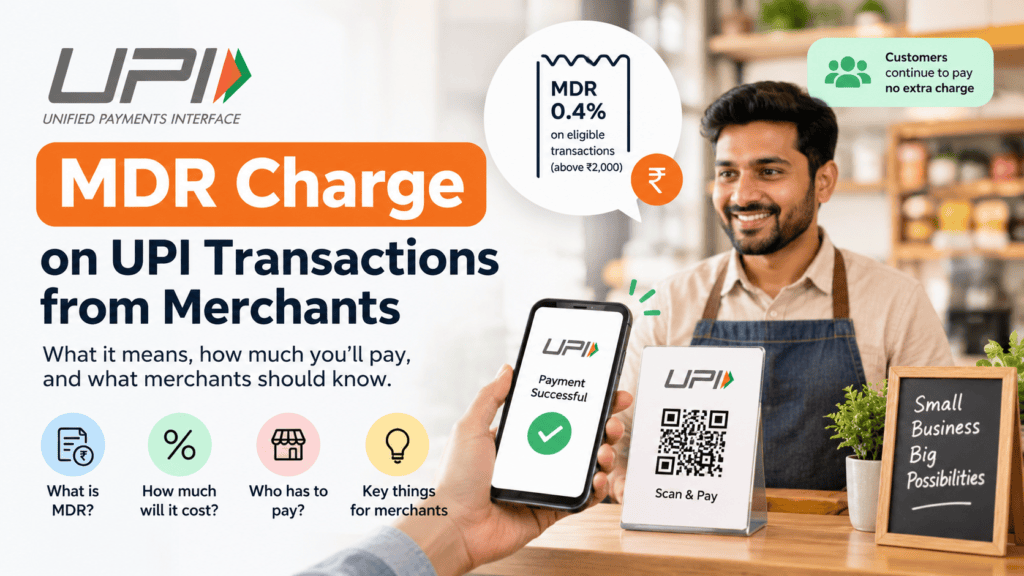
UPI has become one of the easiest ways to receive payments from customers. Earlier, merchants could accept most UPI payments without paying an MDR charge. But now, a new MDR framework has been announced for selected UPI merchant transactions.
The new rules will come into effect from 15 October 2026. The good thing is that customers will continue to use UPI without paying a transaction charge. (Department of Financial Services)
Let’s understand what MDR charges on UPI transactions mean for merchants.
MDR stands for Merchant Discount Rate.
It is a charge paid by a merchant for processing certain digital payments. In simple words, when a customer makes a payment to a merchant through UPI, the merchant may have to pay a small charge for processing that transaction.
The new UPI MDR framework applies to selected Person-to-Merchant (P2M) transactions above ₹2,000 from 15 October 2026. (Moneycontrol)
No, MDR will not be charged on every UPI transaction.
Under the new framework:
UPI payments up to ₹2,000 remain outside the MDR.
Person-to-Person (P2P) UPI transactions remain free.
Selected merchant transactions above ₹2,000 will attract MDR.
The charge is applicable to the merchant, not the customer. (The Financial Express)
This means customers can continue making regular UPI payments without paying an extra UPI transaction fee.
For standard eligible P2M transactions above ₹2,000, the MDR is 0.4% of the transaction value, subject to a maximum charge of ₹300 per transaction.
For example:
| UPI Payment | MDR at 0.4% |
|---|---|
| ₹3,000 | ₹12 |
| ₹10,000 | ₹40 |
| ₹50,000 | ₹200 |
| ₹75,000 | ₹300 |
| ₹1,00,000 | ₹300* |
*The ₹300 cap applies to transactions of ₹75,000 and above. (Moneycontrol)
So, a merchant receiving a ₹10,000 eligible UPI payment would have an MDR of ₹40.
Yes. Some categories have different charges under the new framework.
Certain sectors such as railways, telecom, insurance, fuel and agricultural inputs have a flat MDR of ₹5 for eligible transactions above ₹2,000. Certain capital-market transactions have a separate lower MDR structure. (Moneycontrol)
This means the exact MDR can depend on the type of merchant and the category of transaction.
No.
The MDR is a charge on the merchant side. The government has stated that customers should not be charged this MDR for making UPI payments. (India Today)
For example, if a customer pays ₹10,000 to an eligible merchant through UPI, the customer pays ₹10,000. The applicable MDR is handled on the merchant side.
This is important because UPI will continue to remain free for customers for normal payments.
UPI has grown rapidly in India and is now used for a very large number of transactions. NPCI’s latest statistics show that UPI processed more than 24.5 billion transactions in August 2026. (NPCI)
The new MDR framework is intended to create a source of revenue within the UPI ecosystem and support areas such as payment infrastructure, security and innovation. The Department of Financial Services has also stated that 96% of merchant transactions will continue to remain free under the new framework. (Department of Financial Services)
If you are a merchant accepting UPI payments, you should understand which category your business falls into and check the applicable MDR from your acquiring bank or payment service provider.
You should also:
Check your UPI settlement statements.
Understand the MDR applicable to your transactions.
Keep proper records of payment settlements.
Check whether GST or other applicable charges are shown separately.
Review your payment costs after the new framework starts.
This can help you understand how much you are receiving after payment-related charges.
MDR on UPI transactions is an important change for merchants in India. From 15 October 2026, selected UPI merchant transactions above ₹2,000 will attract MDR, while UPI payments up to ₹2,000 and P2P transactions will remain outside the new MDR framework. Customers will continue to use UPI without paying the MDR. (India Today)
If you are a merchant, understanding these charges can help you manage your business payments better.
If you want to understand financial services, digital payments and other useful topics in a simple way, Vidya Sarthi can help you explore useful information and opportunities.
👉 Visit Vidya Sarthi today and take the next step towards learning and growing your financial knowledge.
Note: The MDR framework described above is based on the announced rules available as of September 2026 and is scheduled to take effect on 15 October 2026.
5 Things Merchants Should Know About MDR Charges on UPI Transactions UPI has become one of the easiest ways to receive payments from customers. Earlier,
Feature SEO Google Ads What is it? Optimizing your website to rank organically on Google Paying Google to display your ads in search results Cost
Welcome to WordPress. This is your first post. Edit or delete it, then start writing!